Core Critical Beliefs – The Fine Art of Asking Questions
Apr 14, 2026
“The PERSON asking the question is the one who will eventually make the decision. So make sure you are fully connected with the PERSON first. Then (decide if you are going to and then) answer their questions.
Great insight. Chris! So…you decide your new belief is “Don’t answer a question until you connect with the person asking first”, how do you do that?
TENSION!
When they meet, both the Buyer and the Seller (Yes! You!) are pretty nervous! The Buyer doesn’t want to be sold, usually because of previous or imagined experiences with salespeople. The Seller doesn’t want to lose the opportunity…even though you can’t lose something you don’t have!
Because of those conditions the character that shows up, in both roles, is usually not the real persona!
We, as sales pros, are responsible for creating an atmosphere of trust and EBS (equal business stature) so that the real characters are willing to show up.
Easier said than done. Behind that tension felt by the Buyer is the conscious desire to acquire as much information as possible. That information could be used to either: 1) allow them to get away from the Seller without having wasted time and/or not having spent money; 2) make the buying decision or to provide enough education so that shopping elsewhere will be easier.
NOTE: In my early days of sales training, I worked with a floor covering company and the owner (Thanks, Jim!) gave me a piece of data I believe approximates the whole world of sales.
In his industry, if a Buyer met a traditional floor-covering salesperson and spent +/- an hour “learning” from the Seller, the Buyer, if not closed, bought from the next salesperson interviewed 76% of the time! (That told me that salesperson A had done the heavy lifting and educated the Buyer so additional shopping was unnecessary!
So…put it in your world, Seller! If you do a great traditional selling job, and present the features and benefits, and answer all the Buyer’s questions, if you don’t close the sale, and that Buyer meets your competition, a significant percentage of the time, the sale will be completed by Seller B. Ouch!
To prevent that, Seller A has to avoid giving information and ANSWERING QUESTIONS! Well, between Chris’s newsletter opener and Jim’s previous story, besides helping to relieve the tension and avoid giving away your information for free, the sales pro has a lot to do!
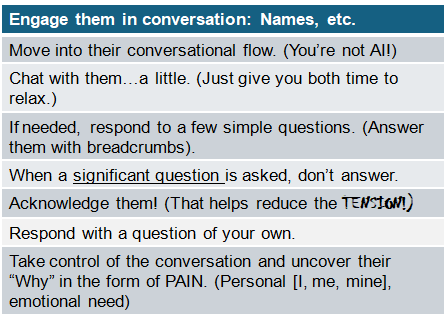
The following will help you with the HOW!(which, after all, is why you’re learning our process!
First AVOID ANSWERING THE QUESTIONS YOU ARE ASKED BY THE BUYER!
Easier said than done, huh? Especially when answering those questions a) encourages the Buyer to like you! b) and shows how much you know about the prod/serv you’re selling!
Taking control, if you know how and are willing to commit to doing it and practice the skills
until you are competent, is not so tough!
Here’s a snapshot of the dialogue! (I’ll try to make it as generic as possible…and also intuitive. And…and this is important: Avoid wordiness! This is not the time to show the Buyer how articulate and knowledgeable you are. You’re not a marketer or human brochure! You are there to close the sale! Keep your dialogue brief and avoid spilling the beans!
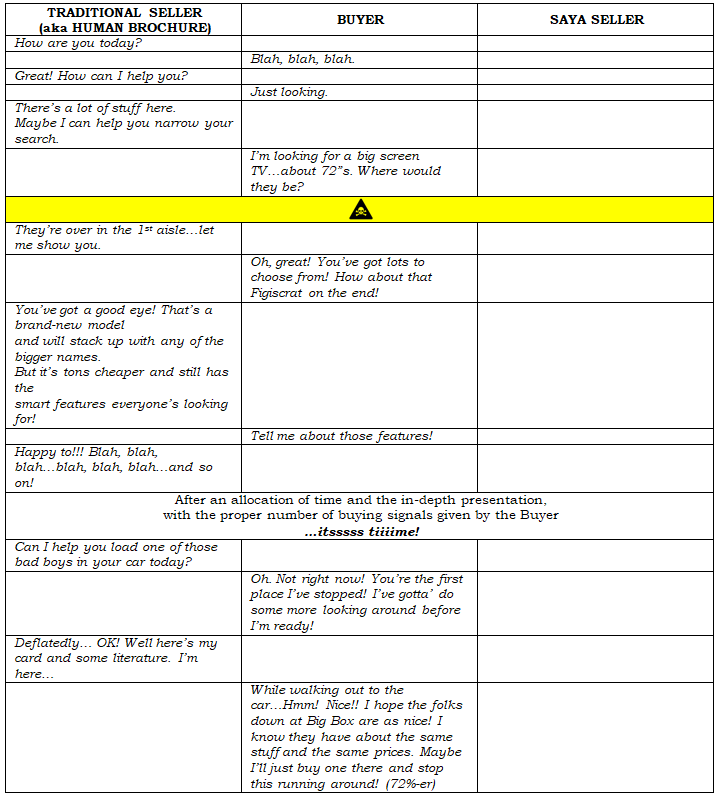
You were probably wondering what the yellow line and the danger symbol in the above dialogue was. If you concluded that was the place the Seller lost control, you were right!As a SAYA Sales Pro, you would recognize that the Trad. Seller has just given away control!
Why is the danger symbol there? ___________________________________________________.
How would we coach that Trad. Seller to react to the question “I’m looking for a big screen TV…about 72”s. Where would they be?___________________________________________________.
How about one of these?
That size sounds important to you. How come?
Sounds like you have a problem with TV size. Why 72”?
I’d be happy to help you look for that…but first may I ask you a question? Why is 72” important?